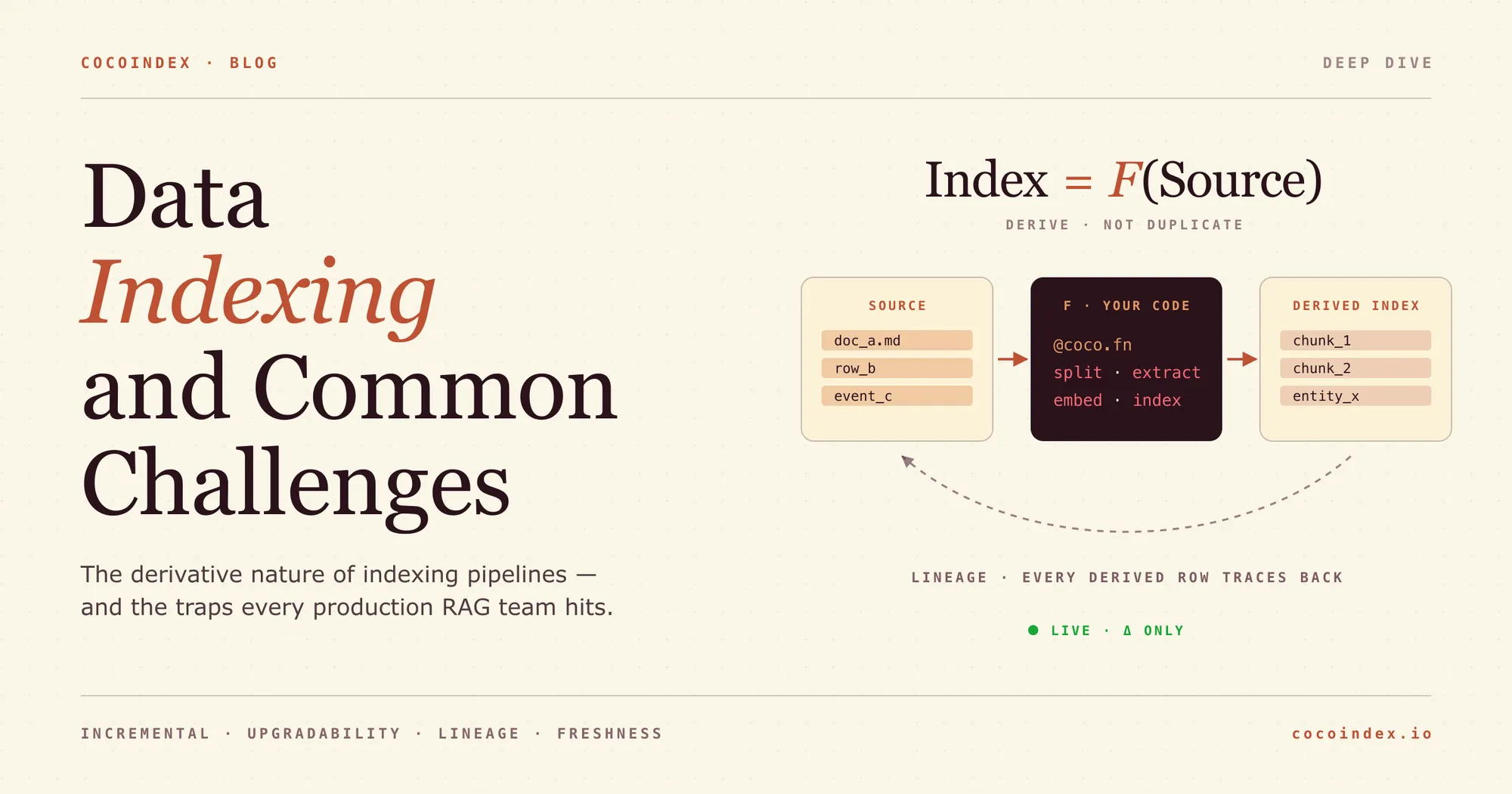
At its core, data indexing is the process of transforming raw data into a format that’s optimized for retrieval. Unlike an arbitrary application that may generate new source-of-truth data, indexing pipelines process existing data in various ways while maintaining trackability back to the original source. This intrinsic nature (being a derivative rather than a source of truth) creates unique challenges and requirements.
Characteristics of a good indexing pipeline
A well-designed indexing pipeline should possess several key traits:
1. Ease of building
People should be able to build a new indexing pipeline without mastering techniques such as database manipulation / access, streaming processing, parallelization, fault recovery, etc. In addition, transformation components (a.k.a. operations) should be easily composable and reusable across different pipelines.
2. Maintainability
The pipeline should be easy to understand, modify, and debug. Complex transformation logic should be manageable without becoming a maintenance burden.
On the other hand, an indexing pipeline is a stateful system, so besides the transformation logic, it’s also important to expose clear status of the pipeline states, e.g. statistics of the number of data entries, their freshness, and how a specific piece of derived data tracks back to the original source.
3. Cost-Effectiveness
Data transformation (with necessary tracking of relationships between data) should be done efficiently without excessive computational or storage costs. Moreover, existing computations should be reused whenever possible. For example, 1% of document change, or a chunking strategy change that only affects 1% of chunks, shouldn’t need to entail rerunning the expensive embedding model over the entire dataset. CocoIndex reuses prior computation through memoization.
4. Indexing Freshness
For many applications, the source of truth for indexing is consistently updated, so it’s important to make sure the indexing pipeline is also updated accordingly in a timely manner with live updates.
Common challenges in indexing pipelines
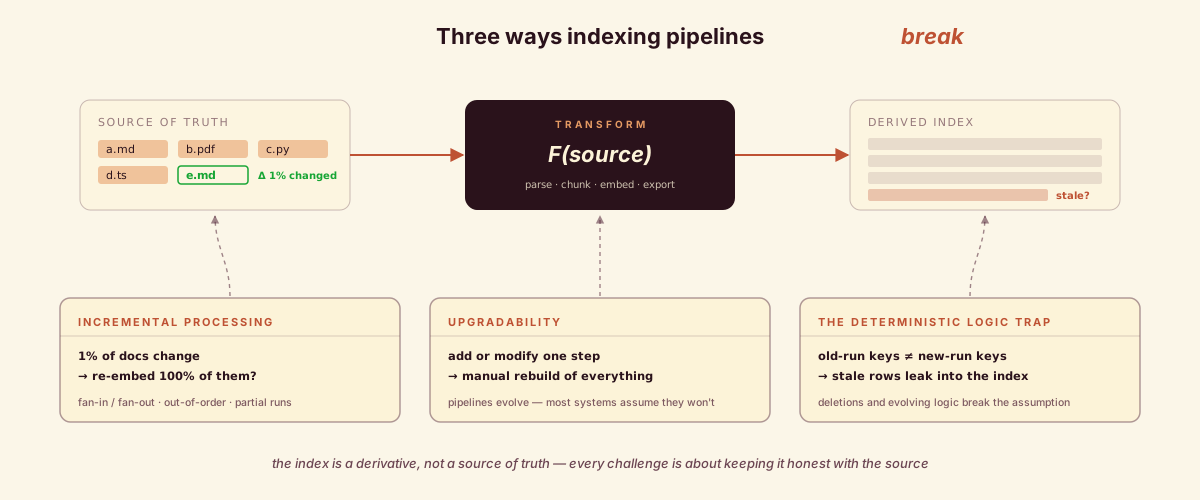
Incremental processing is challenging
The ability to process only new or changed data rather than reprocessing everything is crucial for both cost efficiency and indexing freshness. This becomes especially important as your data grows.
To make incremental processing work, we need to carefully track the state of the pipeline, to decide which portion of the data needs to be reprocessed, and make sure states derived from old versions are fully deleted or replaced. It’s challenging to make things right while considering various complexities, like fan-in / fan-out in transformations, out-of-order processing, recovery after early termination, etc.
Upgradability is often overlooked
Many implementations focus on the initial setup but neglect how the pipeline will evolve. When requirements change or new processing steps need to be added, the system should adapt without requiring a complete rebuild.
Traditional pipeline implementations often struggle with changes to the processing steps. Adding or modifying steps typically requires reprocessing all data, which can be extremely expensive and involves a manual process.
The deterministic logic trap
Many systems require deterministic processing logic - meaning the same input should always produce the same output. This becomes problematic when:
- Entry deletion needs to be handled
- Processing logic naturally evolves
- Keys generated in previous runs don’t match current runs, leading to data leaks
How does CocoIndex solve these challenges?
CocoIndex approaches indexing pipelines with a fundamentally different mental model - similar to how React revolutionized UI development compared to vanilla JavaScript. Instead of focusing on the mechanics of data processing, users can concentrate on their business logic and desired state. See the core concepts for how flows, sources, transforms, and collectors fit together.
The CocoIndex approach:
- Stateless Logic: Users write pure transformation logic without worrying about state management
- Automatic Delta Processing: CocoIndex handles incremental processing efficiently
- Built-in Trackability: Every transformed piece of data maintains its lineage to source
- Flexible Evolution: On pipeline changes, past intermediate states can still be reused whenever possible
- Non-Deterministic Friendly: With data lineage clearly tracked, even without determinism of processing logic, CocoIndex can still make sure stale states are properly purged
Subtle complexities we handle
CocoIndex takes care of many subtle but critical aspects:
- Managing processing state across pipeline updates
- Ensuring data consistency during partial updates
- Smooth recovery from early termination of the pipeline
- Optimizing resource usage automatically
- Maintaining data lineage and relationships
The mental model shift
Just as React changed how developers think about UI updates by introducing the concept of declarative rendering, CocoIndex changes how we think about data indexing. Instead of writing imperative processing logic, users declare their desired transformations and let CocoIndex handle the complexities of efficient execution.
This shift allows developers to focus on what their data should look like rather than the mechanics of how to get it there. The result is more maintainable, efficient, and reliable indexing pipelines that can evolve with your application’s needs.
Conclusion
A well-designed indexing pipeline is crucial for production RAG applications, but building one that’s maintainable, efficient, and evolvable is challenging. CocoIndex provides a framework that handles these complexities while allowing developers to focus on their core business logic. By learning from the challenges faced by traditional approaches, we’ve created a system that makes robust data indexing accessible to everyone building RAG applications.

About the author.

Posts from the CocoIndex team — product launches, release notes, and announcements.
Frequently asked questions.
What makes a good data indexing pipeline?
A well-designed indexing pipeline should be easy to build (without mastering database access, streaming, parallelization, or fault recovery), maintainable (easy to understand, modify, and debug, with clear visibility into pipeline state), cost-effective (reusing existing computation instead of reprocessing everything), and kept fresh as the source of truth changes.
What is data indexing in the context of RAG?
Data indexing is the process of transforming raw data into a format optimized for retrieval. Unlike an application that generates new source-of-truth data, an indexing pipeline processes existing data while maintaining trackability back to the original source. This derivative nature is what creates its unique challenges and requirements.
Why is incremental processing hard for indexing pipelines?
Processing only new or changed data requires carefully tracking pipeline state to decide which portion needs reprocessing, and ensuring states derived from old versions are fully deleted or replaced. Getting this right is difficult once you account for complexities like fan-in / fan-out in transformations, out-of-order processing, and recovery after early termination.
Why do indexing pipelines struggle when you change the processing steps?
Many implementations focus on the initial setup but neglect how the pipeline will evolve. Traditional implementations often struggle with changes to processing steps: adding or modifying a step typically requires reprocessing all data, which is expensive and usually a manual process.
What is the deterministic logic trap in indexing pipelines?
Many systems require deterministic processing logic, where the same input always produces the same output. This becomes problematic when entry deletion needs handling, when processing logic naturally evolves, and when keys generated in previous runs don't match current runs, which leads to stale rows leaking into the index.
How does CocoIndex handle incremental processing and stale data?
CocoIndex uses a declarative model, similar to how React changed UI development: you write stateless transformation logic and declare the desired state, and CocoIndex handles automatic delta processing, built-in trackability of every row's lineage to its source, and flexible evolution that reuses past intermediate states on pipeline changes. Because lineage is tracked, it can purge stale state correctly even when processing logic is non-deterministic.
Does an indexing pipeline have to use deterministic transformation logic?
Not with CocoIndex. Because it clearly tracks data lineage, it can ensure stale states are properly purged even without determinism in the processing logic, making it non-deterministic friendly.
