

Welcome to the official CocoIndex blog! We’re excited to share our journey in building high-performance indexing infrastructure for AI applications.
CocoIndex is designed to provide exceptional velocity for AI systems that need fast, reliable access to their data. Whether you’re building large language models, recommendation systems, or other AI applications, our goal is to make data indexing and retrieval as efficient as possible.
The problem we’re solving
AI applications live and die by the freshness and structure of the data they retrieve. A retrieval system, a recommendation model, or an agent grounding itself in your documents is only as good as the index behind it. The hard part is rarely the first build — it’s keeping that index correct as the world moves underneath it. Both sides change constantly: your source data (new records arrive, old ones get updated or deleted) and your processing logic (you add a field, swap an embedding model, refine a transformation). Most teams answer this by re-running the whole pipeline on a schedule, which is expensive, slow, and disruptive. Doing it properly by hand is worse: you have to compute the delta of what to insert, update, or delete, preserve intermediate state to avoid recomputation, and evolve the target schema when the code changes. With that many moving parts, a small mismatch turns into a subtle bug that’s painful to debug.
How it works at a high level
CocoIndex takes a declarative, state-driven approach. Instead of writing the how of incremental updates, you declare what your target should look like as a function of your source data — and the engine figures out what changed and applies only the necessary updates. If you’ve used spreadsheets, React, or materialized views, the mental model will feel familiar:
- Spreadsheets: you declare formulas in cells; when an upstream cell changes, downstream cells recompute.
- React: you declare your UI as a function of state; when state changes, React re-renders what changed.
- CocoIndex: you declare your target as a function of your source; CocoIndex syncs what changed.
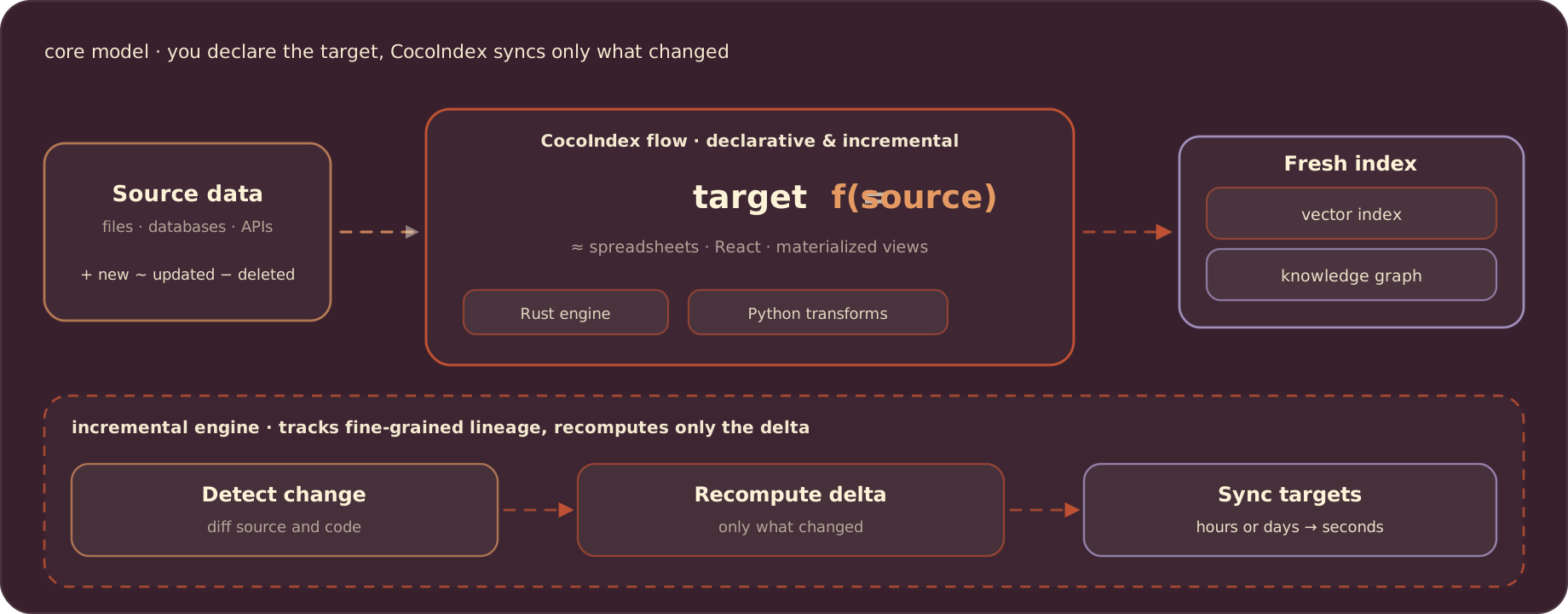
A few properties make this practical at production scale:
- A high-performance Rust engine. Pipelines execute on a Rust runtime built for resilient, scalable data processing, while you write your transformations in plain Python — no new DSL to learn.
- Incremental and low-latency. The engine tracks fine-grained dependencies and only recomputes what changed, in the input data or the code. The same batch-style code runs incrementally in both batch and live mode.
- Full lineage and explainability. Every processing step, intermediate result, and execution path is inspectable — which matters for auditability and transparency requirements.
- An open integration model. Sources and targets plug in through a standard interface, so you’re not locked into a particular database or vector store.
Why incremental processing matters
It’s worth being concrete about why this design pays off, because it’s the heart of what CocoIndex does. When you store derived results in a target for retrieval — embeddings in a vector store, extracted entities in a graph, summaries in a table — both your data and your code keep evolving. Reprocessing everything on every change is the easy answer, and it’s the one most pipelines reach for, but it scales badly: cost grows with the size of your corpus rather than the size of the change, latency climbs, and the index is disrupted while it rebuilds.
Doing incremental updates by hand is genuinely hard. You have to figure out what changed and what didn’t, reason in the time dimension to compute the delta of inserts, updates, and deletes, track intermediate state so you can avoid recomputing work that’s still valid, and evolve the target schema (and backfill it) when the code logic changes. Each of those is a place for a subtle bug to hide. CocoIndex absorbs all of it into the engine: you declare the target, and the framework tracks fine-grained dependencies and recomputes only what changed. In practice this can take end-to-end update times from hours or days down to seconds while preserving correctness — and because every step is inspectable, you can see exactly how a given output was produced.
Who it’s for
If you’re an AI or data engineer wiring up retrieval, building a knowledge graph from documents, indexing a codebase, or feeding a recommendation system, CocoIndex is meant to take the incremental-update burden off your plate. You write the transformation once; the framework keeps the target in sync as data and logic evolve. It fits equally well for someone shipping their first embedding pipeline and for a team operating a large, continuously updated index.
CocoIndex is open source, and the community has been a big part of the journey — the project has crossed 10,000+ stars on GitHub. To go deeper on the mental model, the overview and core concepts pages are the best place to start.
We’ll be sharing:
- Technical deep dives into our architecture and design decisions
- Performance benchmarks and optimization techniques
- Best practices for implementing CocoIndex in your AI systems
- Updates on new features and improvements
- Case studies and success stories from our community
We believe that great infrastructure should be both powerful and accessible. That’s why we’re committed to:
- Building robust, scalable solutions
- Maintaining clear, comprehensive documentation
- Fostering an active, supportive community
- Continuously improving based on user feedback
Stay tuned for regular updates as we continue to enhance CocoIndex and share insights from our development journey. Whether you’re a seasoned AI engineer or just getting started with data indexing, we’re here to help you build faster, more efficient systems.
Follow our GitHub repository to stay up to date with the latest developments!

About the author.

CEO and cofounder of CocoIndex. Writes about incremental data infrastructure, agents, and the engineering decisions behind the engine.
