
High-quality data tailored for specific use cases is essential for successful AI applications in production. The old adage “garbage in, garbage out” rings especially true for modern AI systems - when a RAG pipeline or agent workflow is built on poorly processed, inconsistent, or irrelevant data, no amount of prompt engineering or model sophistication can fully compensate. Even the most advanced AI models can’t magically make sense of low-quality or improperly structured data.
Whether we’re building semantic search, RAG (Retrieval Augmented Generation), or agentic workflows on top of embeddings and knowledge graphs, the foundation of AI applications lies in how well the data is processed and indexed.
This is where CocoIndex comes in - we aim to be the best-in-class scalable data indexing infrastructure with built-in observability and lineage tracking. CocoIndex provides a data-driven programming model where indexing is defined by data flow with clear lineage, making it straightforward to understand and maintain data pipelines.
The job: turn raw sources into AI-ready data
An indexing platform sits between your sources and your AI application. Its job is narrow but unglamorous: take documents, files, rows, and media from wherever they live, transform them into the representations an AI system actually consumes - chunks, embeddings, structured fields, graph relationships - and keep those representations correct as the sources change. Everything in a RAG or agent stack downstream of that - retrieval quality, grounding, the answers a user finally sees - inherits whatever the indexing layer produced. If the chunk boundaries are wrong or the embeddings are stale, the model has no way to recover. Getting this layer right is the highest-leverage work in an AI application, which is exactly why it shouldn’t be re-implemented by hand for every project.
The flow model
CocoIndex describes indexing as a data flow: you declare what the target should contain as a function of the source, and the framework figures out how to get there. This is the same mental model behind spreadsheets, React, and materialized views - you specify formulas or target state, and the system recomputes downstream values when inputs change (see core concepts and the overview). You write ordinary Python transformations; there is no separate DAG, no operators to wire up, and no DSL to learn. Because the flow is declared rather than imperatively scripted, the schema of every step is known at declaration time, before any data runs through it - which lets CocoIndex set up target tables and vector columns automatically and catch type mismatches up front instead of at row 10,000.
What makes data preparation for AI hard?
Building production-ready AI applications requires solving several complex data challenges:
- Connecting to and ingesting data from multiple diverse sources
- Determining optimal chunking strategies for different content types
- Selecting and implementing appropriate embedding models
- Managing vector stores and knowledge graphs efficiently
- Tracking data lineage and ensuring observability
- Detecting and handling content updates across sources
- Managing content staleness and implementing refresh strategies
- Ensuring data consistency during updates and refreshes
- Deduplicating and reconciling relevant data
- Reusing existing computations when possible on incremental changes of source data or transformation logic
These challenges often require significant engineering effort that takes focus away from core business logic development.
How CocoIndex helps
CocoIndex provides a comprehensive platform that handles all aspects of data indexing for AI applications:
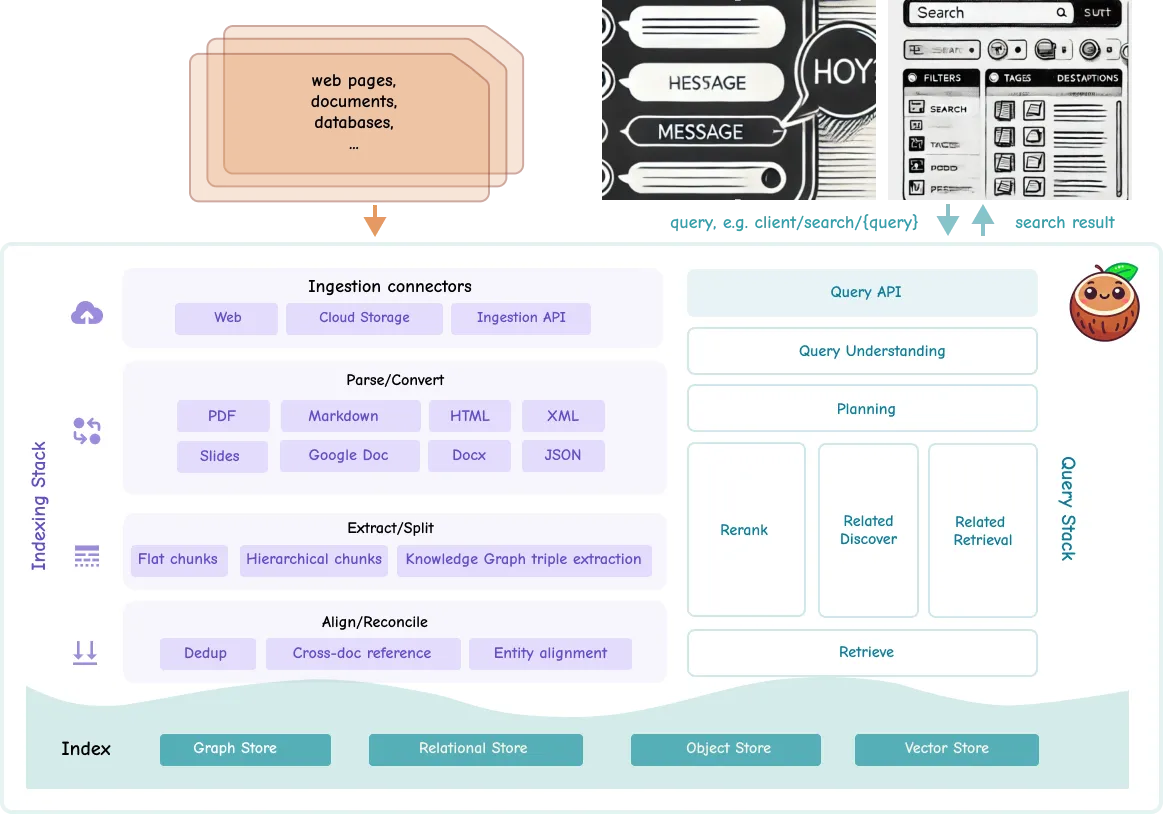
1. Universal data connectivity
We offer seamless integration with various data sources, making it simple to ingest and process content regardless of where it lives.
2. Intelligent indexing strategy
Our platform makes it easy to experiment with and evaluate different indexing strategies, both during development and in production:
- Flexible content chunking with A/B testing support
- Plug-and-play embedding model switching
- Deduplication with content-based and metadata-based matching
- Flexible reconciliation with custom merge strategies and conflict resolution
- Multiple vector store backends with seamless migration
- Extensible knowledge graph schemas
Chunking and embedding are where most retrieval quality is won or lost, so CocoIndex ships these as built-in operations rather than leaving them as glue code. The text ops include a syntax-aware RecursiveSplitter that understands code structure and returns chunks with start/end positions (line, column, and offset) rather than blind character windows, plus a regex-based SeparatorSplitter when you want explicit control. Embedding is just as swappable: the sentence-transformers integration runs models locally with automatic model caching and thread-safe GPU access, and because it advertises its vector dimension and dtype to the connector, switching embedding models doesn’t mean hand-editing your target schema. Trying a different chunk size or a different model is a one-line change, which is what makes systematic A/B evaluation practical instead of aspirational.
3. Robust pipeline management
CocoIndex manages the entire indexing pipeline with:
- Built-in monitoring and observability
- Data lineage tracking
- Automatic updates and maintenance
- Performance optimization
- Error handling and recovery
- Robust out-of-order update handling
- Careful ordinal tracking across all pipeline stages
- Version-aware commit logic to prevent stale data
- Safe concurrent processing of updates
- Data freshness
- Transactional consistency across storage systems
- Clean state management for incremental processing
- Safe deletion of obsolete versions
- Framework-level complexity handling
- Users focus on pure transformations
- Framework manages storage and states
- Automatic delta processing and caching
The piece that ties all of this together is incremental processing. Sources are not static - documents get edited, rows get deleted, and the transformation logic itself evolves as you tune chunking or swap models. Reprocessing everything on every change is expensive, slow, and disruptive, but doing the delta by hand is genuinely hard: you have to determine what changed, compute exactly what to insert, update, or delete in the target, preserve intermediate state to avoid recomputation, and evolve the target schema when the logic changes. CocoIndex does this for you. It tracks fine-grained lineage, so when one source file changes only the chunks and embeddings derived from that file are recomputed, and only the corresponding target rows are touched. It also reuses prior computation through memoization - for example, a file that was merely touched or moved but whose content is unchanged validates against its modification time first and skips re-embedding entirely. The result is that an end-to-end refresh that would otherwise take hours drops to the cost of the actual change, while staying correct.
4. Standardized API access
We provide clean, standard APIs to access indexed data for:
- Semantic searches
- Context retrieval for RAG
- Knowledge graph navigation
Focus on what matters
By handling the heavy lifting of data preparation and indexing, CocoIndex enables:
- Reduced time spent on infrastructure development
- Focus on core business logic
- Faster AI application development
- Maintained high data quality
- Confident scaling
Getting started
Looking to streamline AI application data infrastructure? Check out our documentation to learn more about how CocoIndex can help build robust AI applications with properly indexed data. CocoIndex is open source and has grown to more than 10,000 stars on GitHub, where the project develops in the open.
Join our Discord community to connect with other developers and get support. Follow us on Twitter for the latest updates.
Let CocoIndex handle the complexity of data indexing while you focus on building amazing AI applications!

About the author.

Posts from the CocoIndex team — product launches, release notes, and announcements.
